
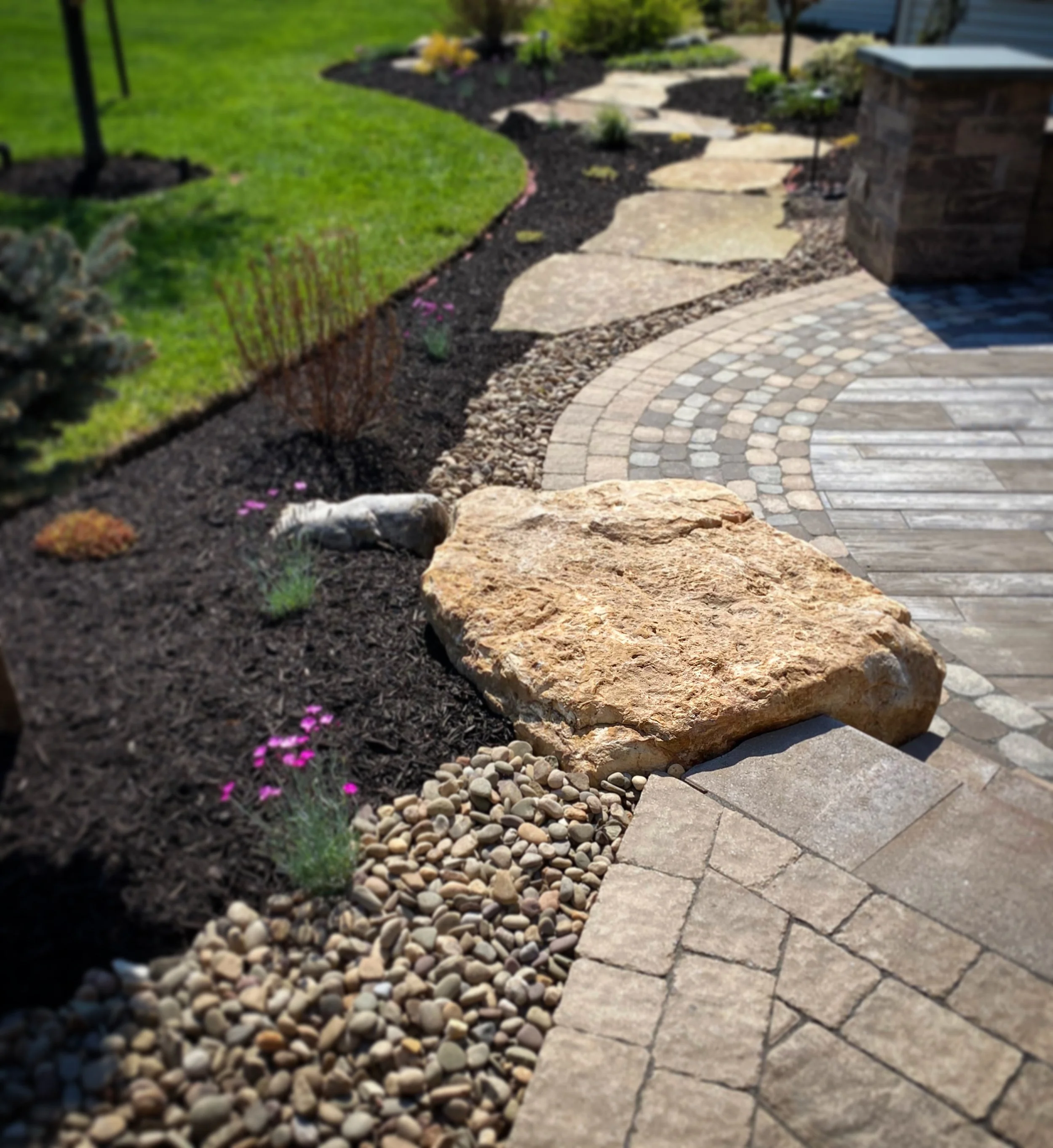
Hiring a paver patio contractor in Hamburg, PA usually starts with competing quotes for the same back patio, and they can arrive with three different totals and three different ideas of what the job includes. Homeowners are gathering more estimates than they did two years ago, and the paper stacks up faster than the answers do. Learning to read a proposal closely is the step that turns a pile of numbers into a decision you can defend.
Nature’s Accents has worked with local businesses and homeowners since 2002, when founders Travis Breininger and Justin Bentz launched the company after earning a Landscape and Nursery degree at Pennsylvania College of Technology.
Our crews hold ICPI and NCMA certifications, and we build as an EP Henry Authorized Hardscape Contractor and a Techo-Pro contractor, which shapes how we write a scope. The sections below follow the order we use when a homeowner sits down with two or three competing bids in front of them.
None of this is about finding the cheapest page in the stack. It is about making three documents describe the same project, so that the differences between them mean something. A proposal is the only evidence you have of how a company thinks before it owns your yard for a month.
What Should a Written Paver Patio Scope Name Line by Line?
A written paver patio scope should name the paver manufacturer, product, color, unit thickness and laying pattern, plus excavation depth, base material and its compacted depth, bedding layer, edge restraint and joint material. Each of those deserves a line of its own rather than being implied. Square footage, linear footage of edging and the count of steps belong in numbers rather than adjectives.
The same page should say what happens to the spoils. Hauling excavated soil off site costs real money, and a proposal that stays silent on it has either buried that cost or left it for a change order. Grading and seeding the disturbed strip around the new patio is another item that quietly disappears from thin bids, so ask each contractor to point at the line where those two things sit.
Paver Patio Proposal Lines That Should Carry a Quantity
Numbers make bids comparable in a way that descriptions cannot. Square feet of finished surface, tons or cubic yards of base stone, linear feet of soldier course and the number of risers all belong in the document.
Once three proposals carry the same four quantities, the price differences start to explain themselves. The patio work we quote carries those quantities because homeowners ask for them, and because our own crews schedule off them.
Why Do Two Paver Patio Bids Measure the Same Yard Differently?
Two bids measure the same yard differently because square footage depends on what each estimator decides to count.
One estimator measures the finished walking surface, a second includes the step treads, and a third counts the area under a grill counter you have not committed to yet. A curved patio measured as a rectangle reads noticeably larger than the shape that gets built, so ask each bidder for the number they used and the sketch it came from.
Two other habits move the figure. Some estimators fold a waste factor into the square footage rather than into the material line, which inflates the area while the price per foot still looks competitive. Others quote the patio area but leave out the walk that connects it to the driveway, then add that later. Lining the three sketches up side by side settles most of this in ten minutes.
How Do Paver Product, Pattern and Cut Waste Change the Number?
Paver product moves a patio budget more than almost any other decision on the page, followed by the laying pattern and the cut waste it generates. A tumbled three piece cobble, a large format slab and a standard rectangular unit sit at different price points and install at different speeds. Thickness matters as well, since a paver rated for vehicle traffic costs more than one rated for foot traffic. Two bids naming different manufacturers are not comparable until someone prices the same unit through both.
Pattern drives labor and waste together. A running bond laid square to the house cuts quickly and wastes little, while a forty five degree herringbone or a circle kit against a curved edge generates saw work on every border.
Ask what waste percentage each contractor carried and how they intend to finish the border. We build with EP Henry and Techo-Bloc units, so we price one pattern in two product lines and let a homeowner see the spread.
Paver Borders, Inlays and the Cost of a Curve
Curves look effortless on a plan and price like detail work in the field. Every arc in a border means a saw cut on each unit that meets it, plus a soldier course set piece by piece.
A contractor who prices a curved patio the same as a rectangle of equal area has either absorbed that labor or has not thought about it yet. The walkway and driveway paving we install follows the same rule, and we put it on the page.
Where Do Allowances and Exclusions Hide in a Paver Patio Proposal?
Allowances hide in placeholder price lines, and exclusions hide in a short list near the back of the document. A line reading “paver allowance of six dollars per square foot” means the total on the last page holds only if you choose from a narrow shelf.
Lighting allowances, step tread allowances and fire feature allowances behave the same way, so ask what product sits at the allowance figure and what the upgrade you want would add to it.
Exclusions do quieter damage. Permits, utility locates, dumpster fees, sod repair, downspout connections and irrigation head relocation are common exclusions that later arrive as invoices. A proposal with a short exclusions list is usually incomplete rather than generous, and reading the exclusions before the scope is often the faster way through a document.
How Do Site Access and Grade Get Priced?
Site access and grade get priced as labor and as added structure, and both belong on the page as their own lines. A side yard wide enough for a compact track loader lets a crew move base stone by machine, while a four foot gate turns the same tonnage into wheelbarrow work. On a large patio that difference runs into days of labor, so walk each estimator down the route their machines would take and watch what they write down.
Grade and existing structures do the same thing to a number. A yard that falls away from the house needs elevation held somewhere, which is where a wall or a run of steps enters the budget. Existing decks, condenser units, window wells and mature root systems each change the sequence of the build. We price retaining wall construction as its own line when the grade calls for it, rather than folding it into a square foot rate.
Site protection belongs in the same conversation. Ask how the crew will reach the back yard without rutting the lawn, what gets laid down to spread the weight of a loaded machine, and who repairs the route afterward. A proposal that carries a restoration line for the access path has thought the job through to its last day.
What a Paver Patio Site Visit Should Produce
A serious estimator leaves your property with more than a phone photo. Expect measurements, spot elevations at the house and at the low corner, a note on where water currently leaves the yard and an image of the access route.
Proposals built from that visit tend to survive contact with the excavator, while proposals built from satellite imagery tend to generate change orders in the first week.
Related: Guide Guests Through Your Backyard Oasis With a Custom Paver Walkway in Schnecksville, PA

What Does a Paver Patio Warranty Cover?
A paver patio installer warranty covers settlement, joint failure and edge movement caused by how the patio was built, while the manufacturer warranty covers the units themselves against structural failure. Manufacturer coverage follows the product rather than the installer. The installer warranty is the one worth reading closely, so ask for the term in years, in writing, and ask what voids it.
Terms vary widely across Berks County and the Schuylkill Valley, and a one year installer warranty on a patio that will move through a full Pennsylvania freeze and thaw season is a short promise. Ask whether the coverage transfers if you sell the house, and confirm that it includes labor as well as material. Ask who answers the phone in year three, a question a company at the same address for two decades answers quickly.
Written detail beats a verbal assurance on this point. A warranty that names what counts as settlement, gives a tolerance over a span, and states a response time is a document a homeowner can use. A warranty that says only that the work is guaranteed is a sentence rather than a remedy.
What Should You Verify About Insurance and the Crew on Site?
Verify general liability and workers compensation coverage, a Pennsylvania home improvement contractor registration number, and who will be working in your yard. Ask for certificates listing you as certificate holder, issued by the agent rather than forwarded as a screenshot, and confirm the policy dates cover your build window. The registration number belongs on the proposal itself.
Then ask who is going to be in the yard. Some companies run a single crew under an owner who walks every job, while others hand the hardscape portion to a rotating set of installers. Neither arrangement is automatically wrong, but the answer tells you who to call when a soldier course looks off. Our ICPI and NCMA certifications sit with the people setting the stone, not only with the office.
Which Questions Close the Gap Between Two Similar Paver Patio Bids?
Addresses of older patios, a daylight look at the paver sample and a clear end-of-day site routine close the gap when two proposals land within a few hundred dollars of each other.
Ask each contractor for three patios they built four or more years ago, then drive past them and look at the joints and the edges. Ask to see a sample of the unit in daylight rather than a catalog image, and ask what the crew does at the end of each day with tools, spoils and an open excavation.
One more question tends to be revealing. Ask each bidder what they would change about your plan if the budget stayed exactly the same, and listen for a specific answer about elevation, traffic pattern or unit size. An estimator who has walked the property will have an opinion ready, and one who has not will agree with everything you say.
How Should Payment Schedules and Change Orders Read?
A reasonable payment schedule runs a deposit near one third, a progress payment tied to a milestone such as base completion, and a final payment at substantial completion. Most established builders work comfortably within that structure.
Be cautious with a schedule that asks for the majority of the money before material arrives, and equally cautious with one that asks for nothing until the end, since that often signals thin working capital.
Change order language deserves one careful read before you sign anything. It should state that changes are documented in writing, with a price and a schedule impact, before the work proceeds. It should also name who can authorize one, which keeps a casual driveway conversation from becoming a four figure line item.
The Construction Schedule Is Part of the Proposal
Ask each bidder for a start window and a working day count rather than a season. Crew capacity across the region is tight this year, and a proposal naming a real construction calendar is worth more than one naming a lower number. Ask what happens if rain pushes the start, and who calls you when it does, because certainty that the project finishes on a known date is much of what a homeowner is buying.
Compare Paver Patio Contractor Quotes in Hamburg, PA With Our Team
Spread the proposals out and let our team walk them with you line by line. Nature’s Accents designs and installs paver patios for homeowners in Hamburg, across Berks County and through the Schuylkill Valley, and we will show you which lines in our scope match the others and which do not.
Send over the drawings you have collected, and we will put a written scope in your hands that you can compare item for item.
Call Nature’s Accents at 610-488-8200 to review your paver patio quotes.
In Summary
How long does a paver patio installation in Hamburg, PA take once work begins?
Most residential patios run one to three weeks of working days once excavation starts, depending on square footage, access and how much wall or step work sits in the scope. Utility locates and wet weather stretch that window, so ask for a working day count rather than a calendar date.
How does a paver patio project get phased across two seasons?
A paver patio project gets phased by building the patio surface and its base in one season, then adding steps, a seat wall or lighting the following year. Phasing works when the original drawing reserves the elevations and connections for the later stage, so ask each contractor to show that on the plan.
Who decides whether a paver patio needs a permit in Berks County?
Your township decides whether a paver patio needs a permit, and some Berks County municipalities regulate impervious coverage or setbacks even for a patio set at existing grade. Confirm with your township office before you sign, and ask each contractor, Nature’s Accents included, to state in writing who is responsible for pulling any permit that applies.
